CASE STUDY · AI PROTOTYPE
The Concierge:
AI Creative Intake
Ask first. Make it second.
ROLE
Concept, system design, and prototype build
SCOPE
Creative intake, prioritization rubric, asset reuse, demand reporting, and a full brand for a fictional company
PARTNERS
Claude, a custom routing rubric, and a 40-item sample asset library
Guava is a fictional company I built for this prototype in order to show a working tool without exposing HubSpot or client work. The problem is real.
01 · THE PROBLEM
A good process that still leaked.
At HubSpot, our project management team ran creative intake through a form that sorted self-serve work from one-off requests. Self-serve went straight to the DAM. One-offs went to a PM, then a scoping meeting with a design leader. I sat in a lot of those meetings for the brand team.
It was a well-designed system, and it still leaked in two places. The form relied on requesters to diagnose their own needs, so plenty of one-offs turned out to be self-serve, or close to something we'd already made, and we only found out in the meeting.
And the meeting's real job was translation. Non-creatives often struggle to say what they need, so we spent the call turning a vague ask into a brief a designer could actually act on.
Neither of those needed a creative leader's judgment. That's the part I'd automate.
The Concierge is what I'd build today: it checks the library itself instead of asking requesters to manually comb through it, and it turns a vague ask into a brief designers can act on, before a person ever gets involved.
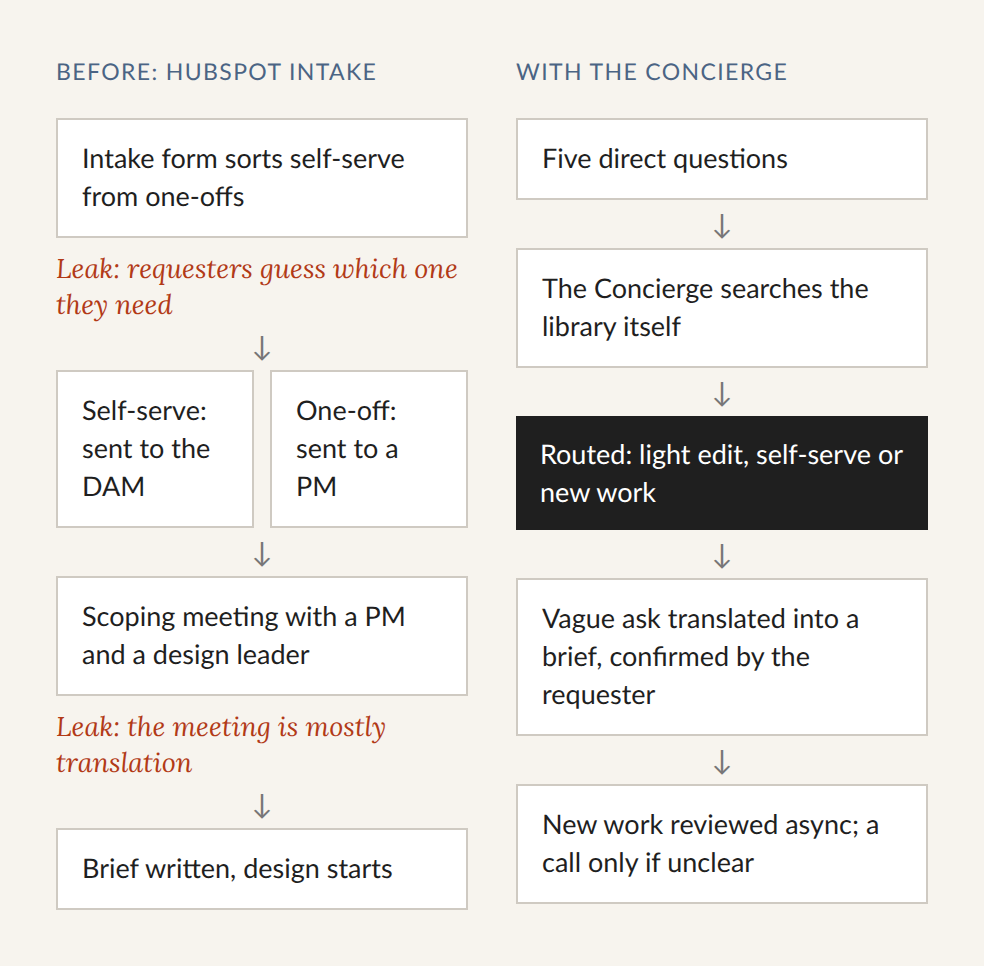
Same questions, same judgment. The guessing and the translation move from a meeting to a conversation.
02 · THE IDEA
Put an agent at the front door.
It asks the five questions every time, the same way, for every requester. Then it does the part humans hate: searching everything the team has ever made before asking for help. The AI does the listening, the brand lead sets the rules.
03 · MY ROLE
What I Built
I designed the intake, the prioritization model and the asset system, then built a working prototype on a fictional enterprise brand so every piece could be tested end to end.
Intake Design
A conversation that scopes like a sharp creative ops partner. Five direct questions, then plain-language translation of vague asks into a brief the requester confirms.
Asset Taxonomy
A tagging structure (product, type, audience, industry, region) that makes the library searchable, shown with 40 sample entries.
Prioritization Model
Five factors scored on every request, with the brand lead deciding how much each one counts, so routing is a policy instead of a judgment call made in Slack.
The Guava Brand
A full fictional identity with products, an event brand and a house style, so the prototype feels like a real enterprise company.
Prototype built with Claude.
04 · HOW IT WORKS
Scope. Search. Route.
Three requests, three routes, one minute.
Scope the ask
Every request gets the same five direct questions, one at a time. The Concierge skips anything the requester already answered.
What’s the business goal?
01
Who’s the audience?
02
What’s the deadline? What’s driving it?
03
Is that date fixed or flexible? Is anything else scheduled around it?
04
Does it drive revenue, support a company priority, or meet a customer need?
05
The follow-up on question four matters most. People call every deadline fixed. Asking what's scheduled around the date gets the real answer, without implying the studio might be late.
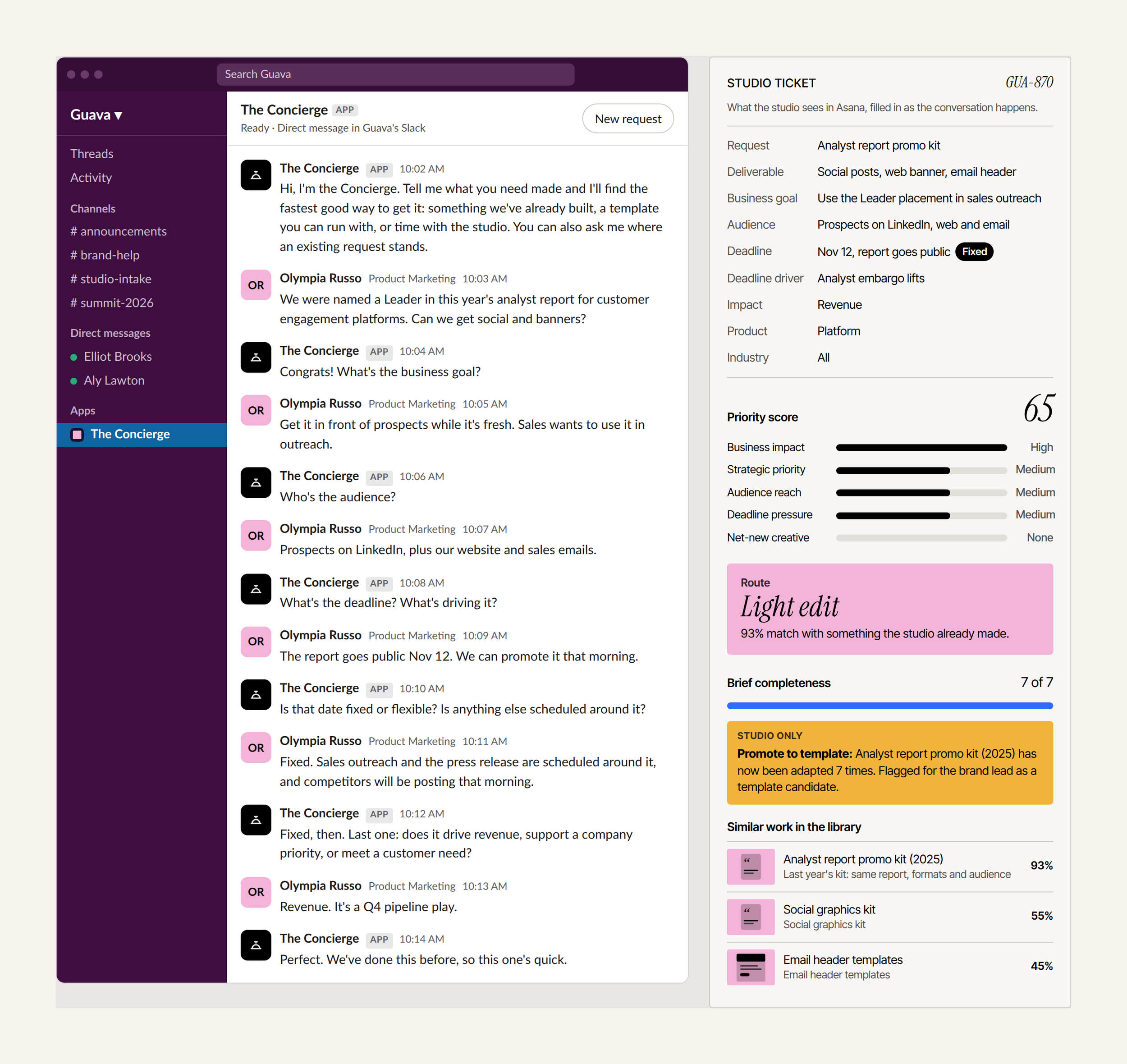
Five direct questions in a Slack DM, with the studio ticket filling in as she answers.
Check the library
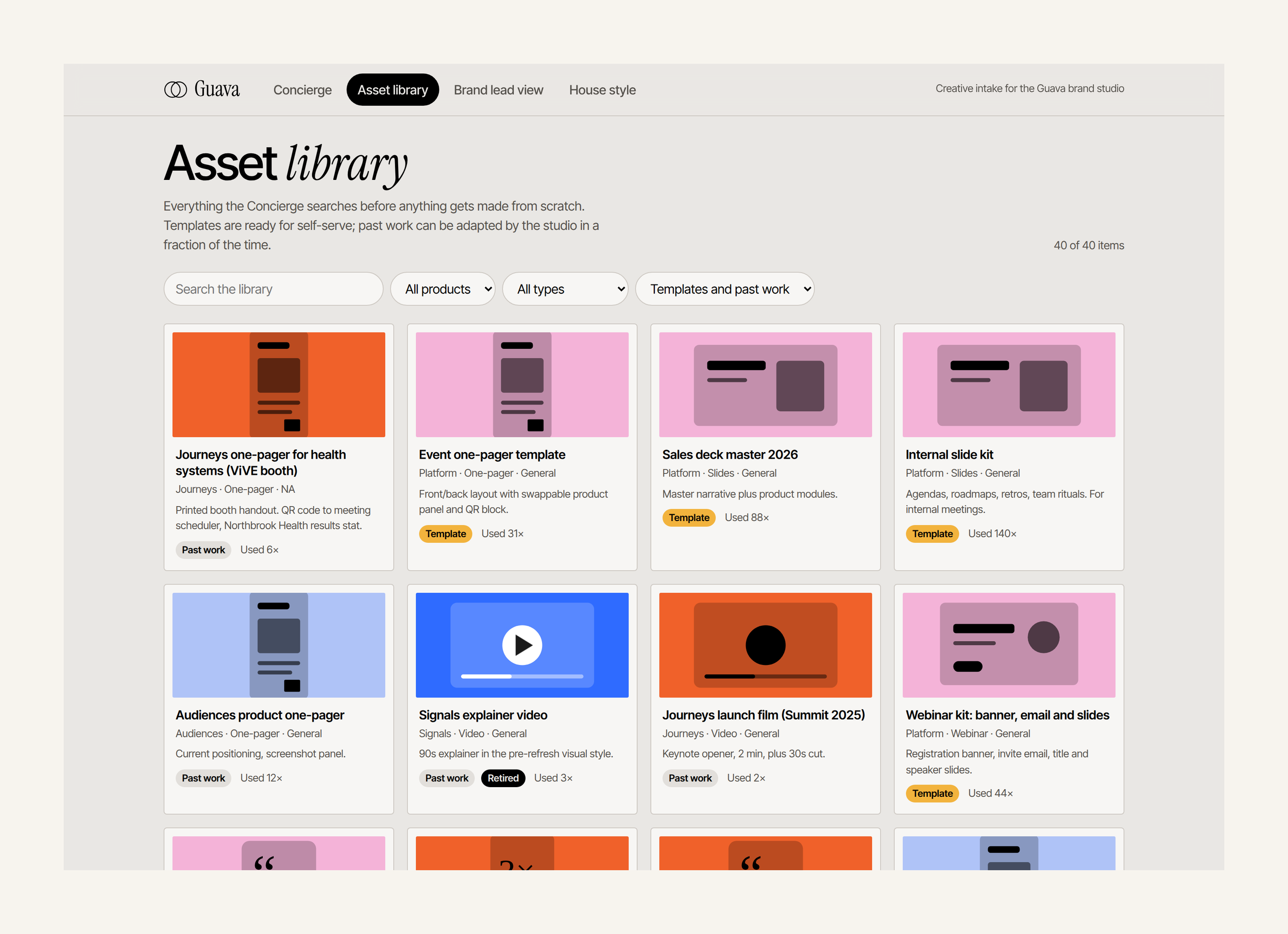
Every request is matched against templates and past work, tagged by product, audience, industry and region. Each match shows a fit score and a reason, so nobody has to take the agents word for it.
The asset library: 40 templates and past pieces, searched before anything gets made. Only approved work from the DAM is recommended.
Route it
Every request lands in one of three places.
Light edit. Past work that's close enough gets a quick studio edit, an hour instead of a week, with a list of exactly what changes.
Self-serve. Lower-priority work gets the right template and tailored tips. A "no" that still helps.
New work. High-priority work goes to the studio with a complete brief. Brand decisions go to the brand lead first.
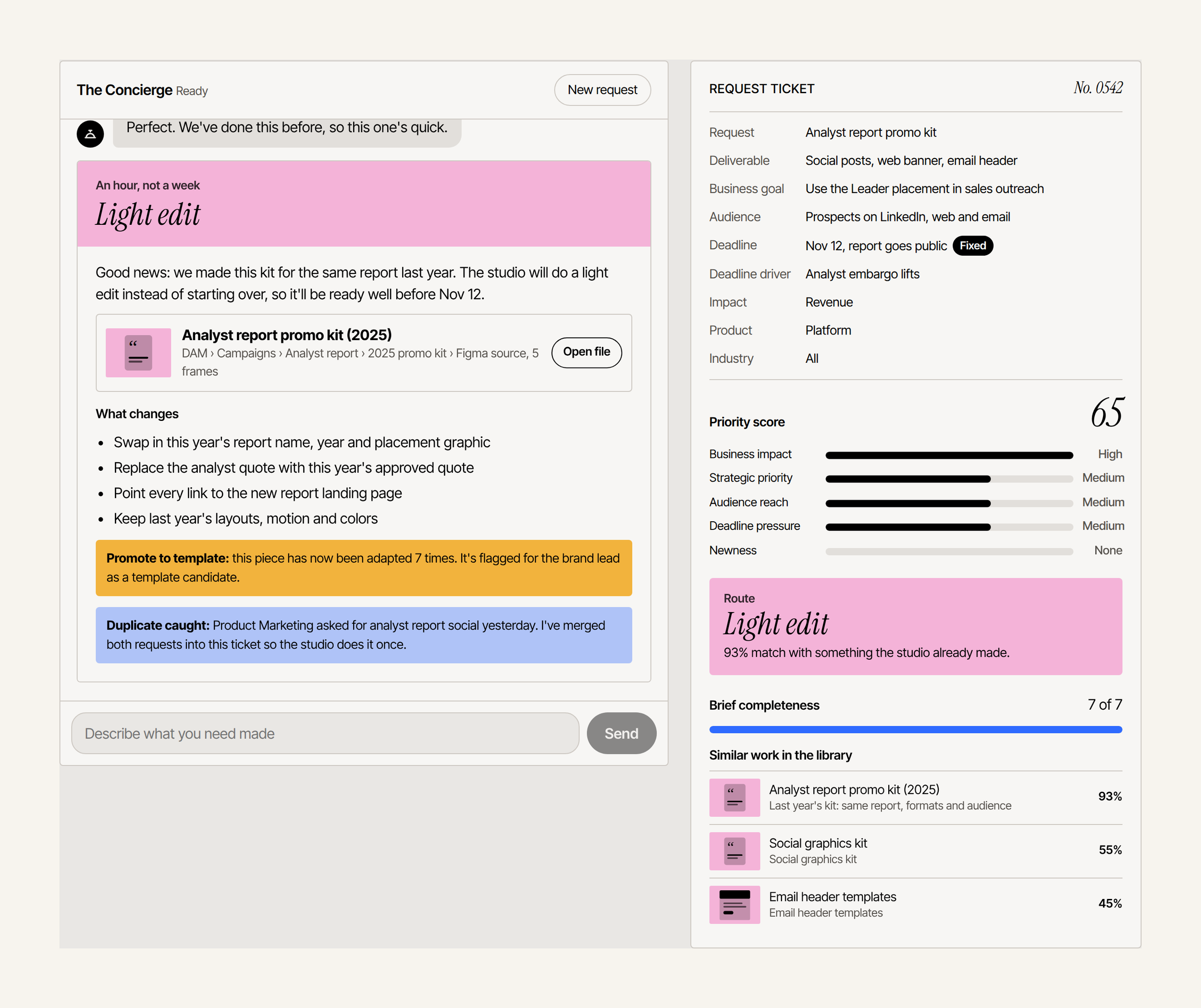
Last year's analyst report kit, linked to the exact file. A duplicate request from another team gets merged, and the piece is flagged to become a template.
Write the brief
Most requesters aren't creatives, and they shouldn't have to be. "Make it pop" and "something modern" are honest descriptions of what people want. They just aren't briefs.
For new work, the Concierge keeps going until the brief is complete: scope, success criteria, approver, feedback owner and references. It asks plain-language questions, like "If a customer remembers one thing, what should it be?", and translates the answers into direction a designer can act on.
It also reads Guava's brand guidelines and brand architecture, so the brief includes the rules a requester wouldn't know, like staying inside the type and color system, or that features don't get their own logos. The brief labels which requirements came from the requester and which came from the guidelines.
Before anything is sent, the requester sees the brief next to their own words, flags anything that's off, and approves it. Misunderstandings get caught in the conversation, not in the first round of design.
And when a request is really a brand decision, like a new feature asking for its own logo, it goes to the brand lead before anyone opens a design file.
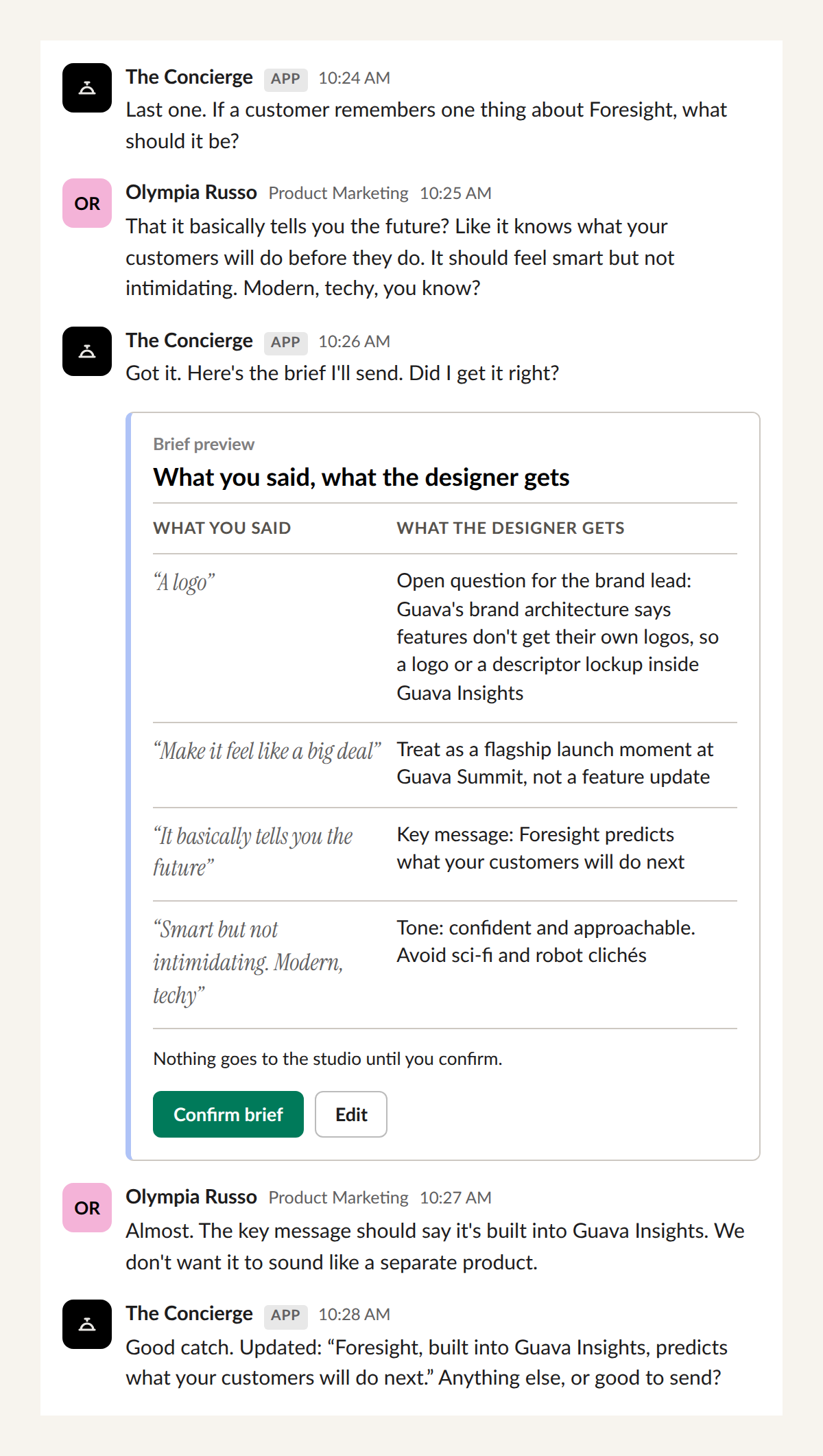
The finished brief
"Smart but not intimidating. Modern, techy" becomes a tone a designer can use. The requester flags one fix, then approves.
Built on the brief format I use as a creative lead. The Concierge fills in everything the requester can answer, and adds brand requirements from Guava's guidelines. Roles like the driver and contributors, the design system notes and the feedback process are left for the studio to complete.
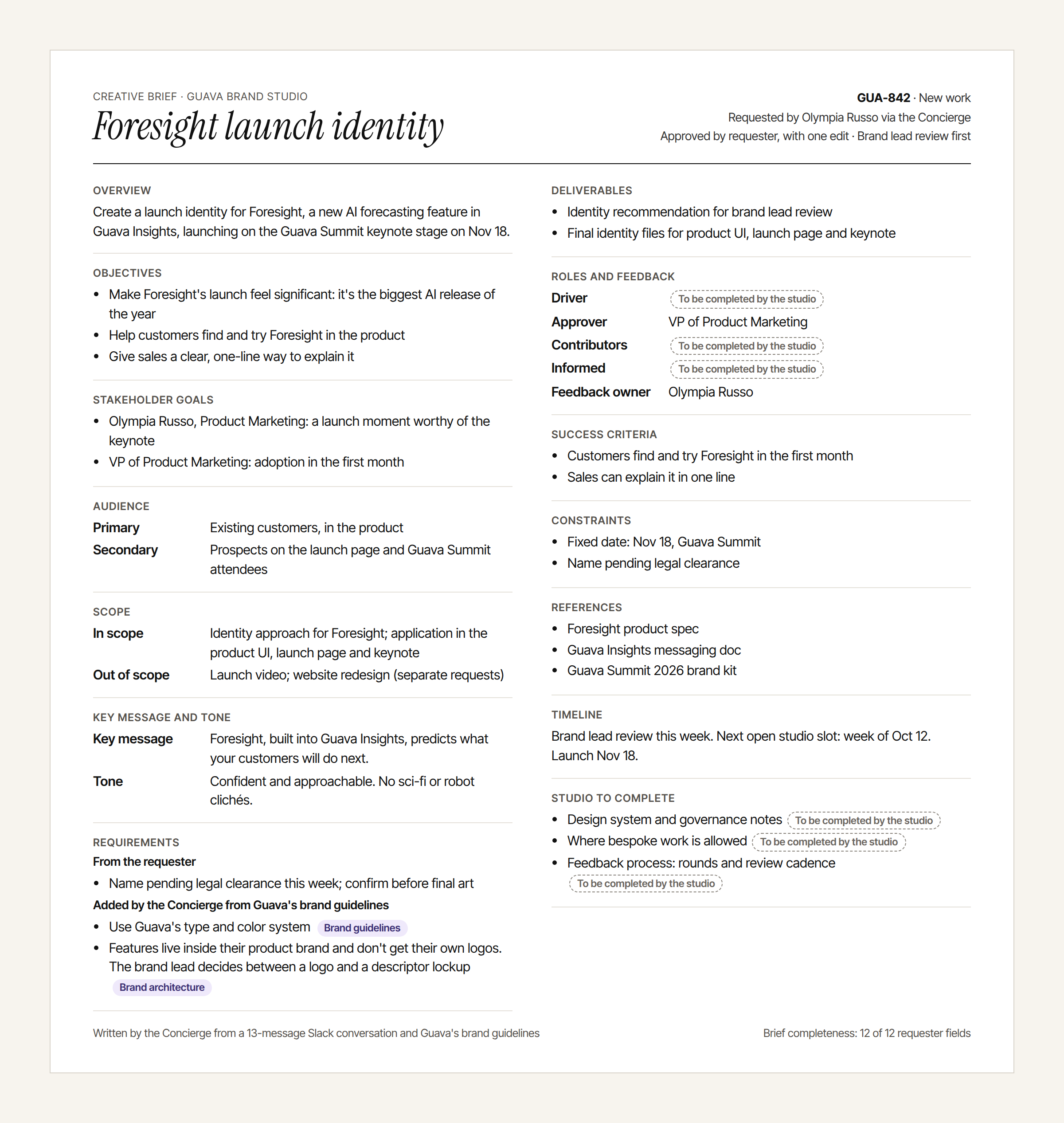
Written by the Concierge from a short Slack conversation and Guava's brand guidelines. Dashed fields are left for the studio.
Also built in
Repeat work becomes templates
When the studio keeps adapting the same piece, the Concierge flags it for the brand lead to turn into a template anyone can use.
Duplicates merged
When two teams ask for the same thing, the requests become one ticket and the studio does it once.
The exact file
Links go to the specific file and frame in the DAM or Figma, always the latest approved version.
Async review
Design leads review briefs in a Slack thread. A call happens only when something is unclear.
Only approved work
The DAM is the source of truth. Outdated versions found in Drive or old tickets are never suggested.
Dates and status
New work gets a realistic start date based on studio capacity, and "Where's my request?" gets answered by the Concierge instead of a PM.
05 · THE BRAND LEAD’S VIEW
Priority becomes a policy.
Only the brand and studio team see this view. Most AI tools don't show how they make decisions. This one does. The AI gathers the facts and scores five factors: business impact, strategic priority, audience reach, deadline pressure and net-new creative (how much new work it needs, which is none if something close already exists). The brand lead decides how much each factor counts toward priority, and those rules decide the route.
Change a weight and you see the consequence immediately: how last quarter's requests would have routed, and whether the studio lands over or under capacity.
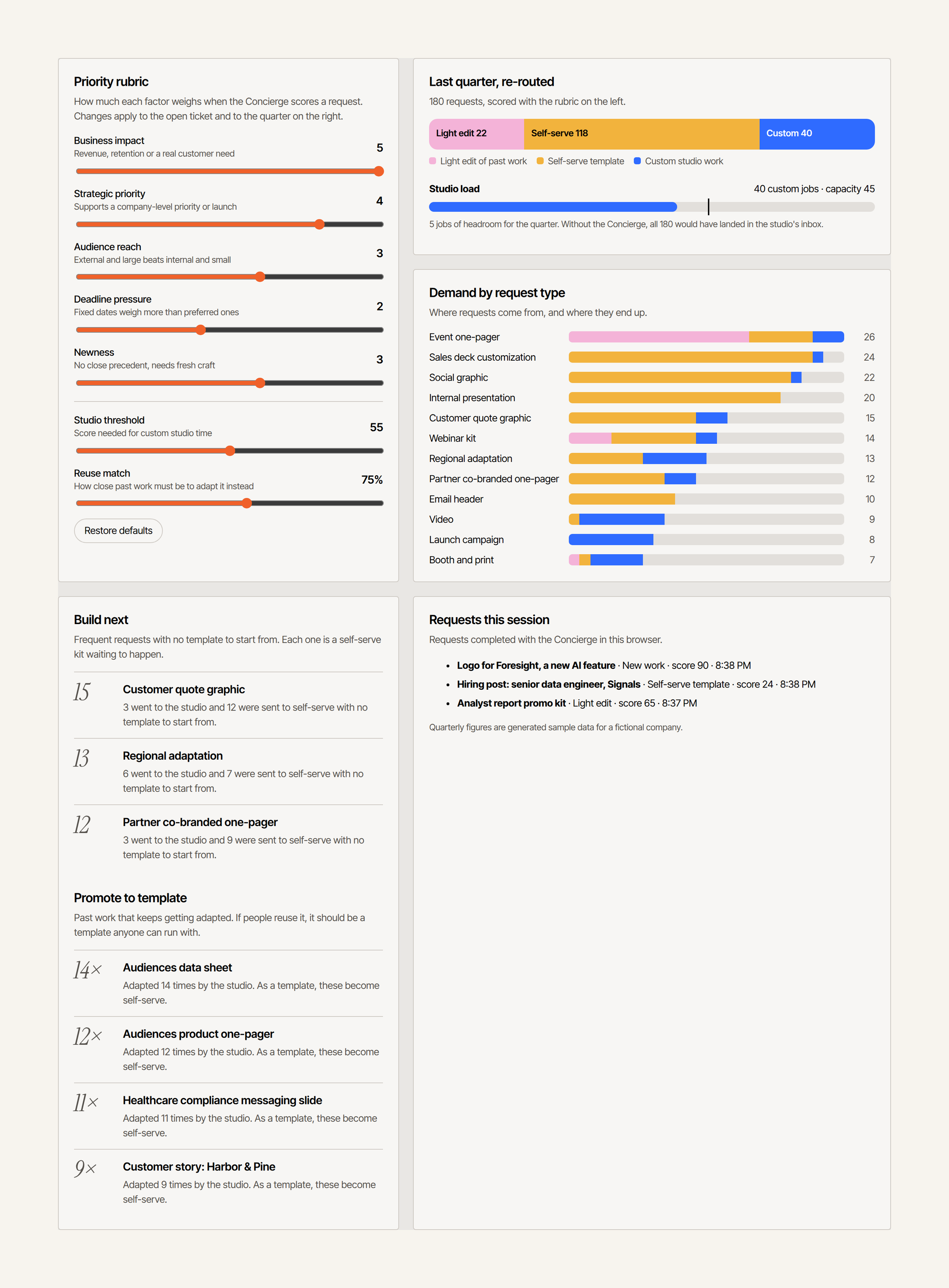
The brand lead view: tune the rubric, watch a quarter of requests re-route in real time.
Intake data is a roadmap.
Every request tells you something. Log them all and patterns show up. Customer quote graphics came up 15 times in a quarter with no template to start from. That isn't 15 design jobs. It's one template waiting to happen. The same goes for past work: when the studio keeps adapting the same piece, the Concierge flags it to become a template. If people reuse it, anyone should be able to. Triage protects the team this quarter. A system that learns from its own demand makes the team faster every quarter after.
15
requests, one missing template
06 · THE GUAVA BRAND
A fictional company, built like a real one.
A tool like this only proves itself against real complexity, so Guava got a real brand architecture: a master brand, three product lines, an event brand, and industry and regional variants.
The identity pairs flat color blocks with a signature mesh gradient, and a plain grotesk with an italic serif, so the library of sample assets reads like the work of an actual in-house studio.
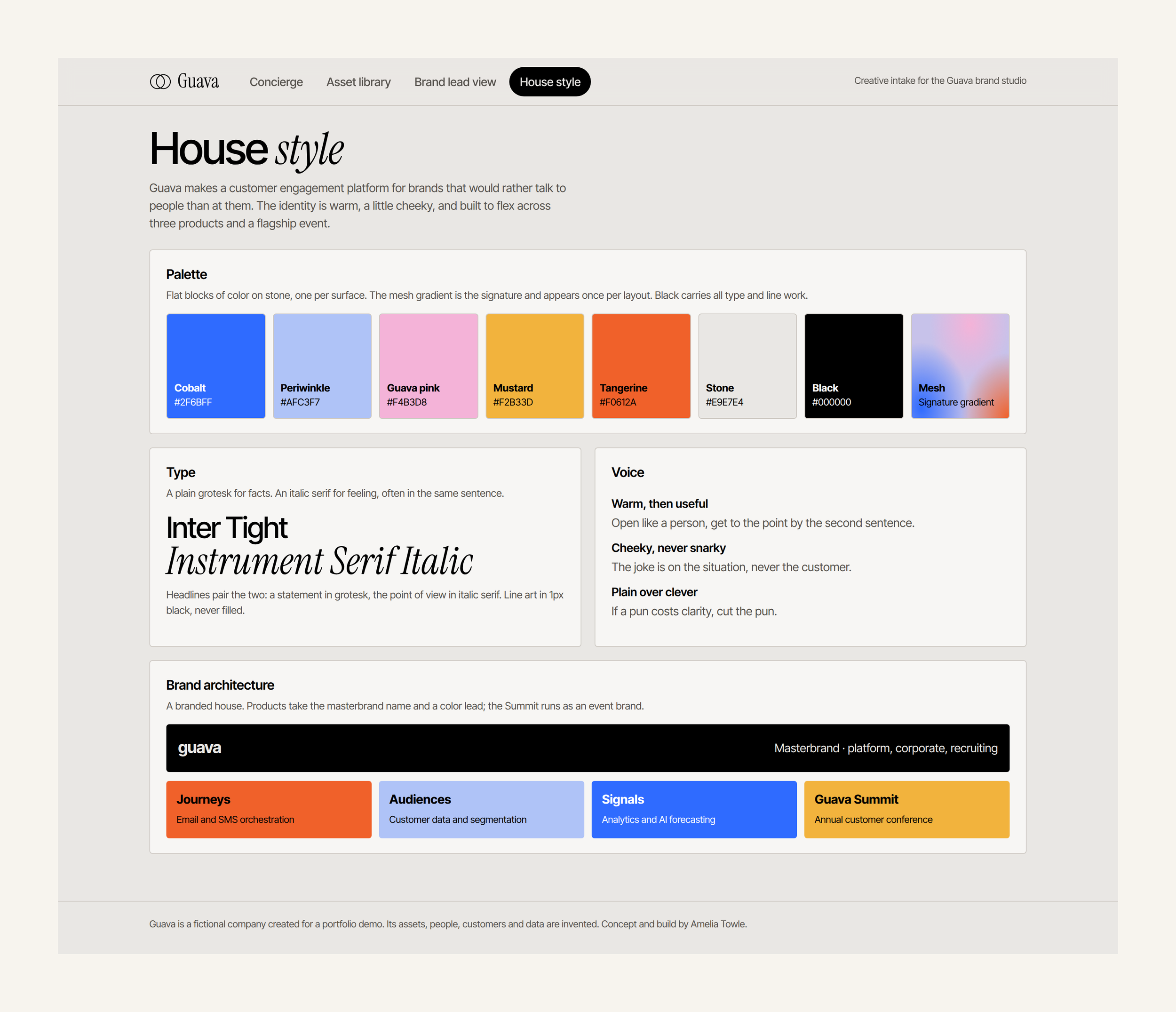
Guava's house style, used across the prototype and its asset library.
07 · MAKING IT REAL
The AI is the easy part.
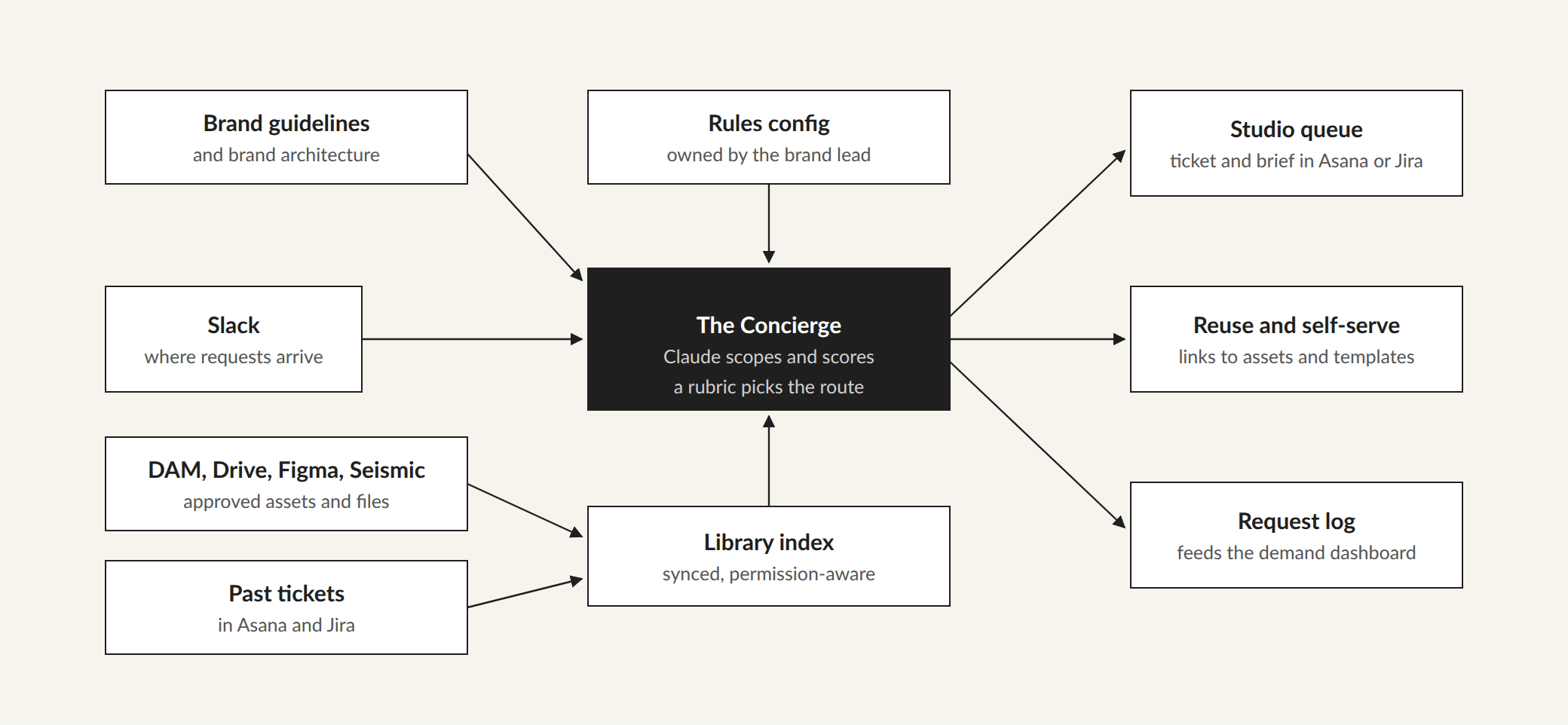
The prototype runs on a sample library. In a real company, the Concierge plugs into the tools people already use, and none of them need to change.
How the Concierge connects to a company's existing tools.
Slack is the front door
Requests already arrive there, so the agent lives there, with a simple form as a fallback.
Claude does the listening
It runs the conversation and scores each request. Rules the brand lead controls make the call.
The library is the memory
The DAM, Drive, Figma, Seismic, past tickets in Asana and Jira, and the brand guidelines sync into one searchable index that respects permissions.
The project tool is the handoff
Custom work lands as a ticket with the brief attached. Every request feeds the dashboard.
Pilot, a few weeks
Test it with one team, using tools the company already has: Slack, an automation tool, and a shared spreadsheet of assets.
Production
Roll it out company-wide. An engineer connects it directly to the DAM and the project tools so it stays accurate and secure. I own the intake, rules, taxonomy and rollout.
Where implementations actually struggle
Not the build. The hard parts are the ones I've spent nine years on: a DAM tagged well enough to search, leadership agreement on what "high priority" means, and getting people to use the front door instead of DMing a designer.
08 · THE RESULTS
What to measure.
Guava is fictional, so I won't pretend to have results. In a real rollout I'd track time from request to scoped brief, the share of requests resolved without studio time, library reuse, studio capacity spent on top-priority work, and whether requesters actually like using it.
3
Routes for every request: light edit, self-serve or new work
5
Priority factors, weighted by the brand lead
40
Assets checked before anything gets made
Pilot it with a real studio for one quarter.
The request data alone would be worth it.
WHAT I’D DO NEXT